
For a wedding cocktail hour, pick curated background music at low-to-moderate energy that supports conversation, not dance-floor excitement. Choose one mood (jazzy lounge, bossa nova, acoustic pop), stick to roughly 20 songs per hour, and let a live ensemble or a well-built playlist handle the rest. Some bespoke music providers build these sets for clients across the Côte d'Azur every season, and the same math applies whether you hire a trio or press play on Spotify.
TL;DR:
- Play roughly 15 to 20 songs per hour, focusing on instrumental or acoustic versions to keep the environment relaxed and conversation-friendly.
- Choose a mood that aligns with your venue, guest list, and season, such as jazz standards for formal indoors or bossa nova for outdoor settings.
- For outdoor venues or diverse guest ages, prioritize acoustic or Latin jazz to enhance warmth without overwhelming the space.
- Use a sound system with even coverage and adjust volume to stay within 60 to 68 decibels to facilitate comfortable conversations.
- Live ensembles can adapt pacing in real time and are ideal for personalized, venue-specific performances, whereas playlists are cost-effective but less flexible.
Table of Contents
- Cocktail Hour Playlist Ideas by Mood
- How to Choose the Right Tempo and Song Mix
- Live Musicians, DJ, or a Playlist: Which Fits Your Wedding?
- Volume, Placement, and Pacing That Actually Work
- How Many Songs Do You Actually Need?
- Setting Up Sound Equipment for Cocktail Hour
- Do You Need a License to Play Music at Your Wedding?
- Musicaluxe's Perspective: What Live Ensembles Get Right
- Book a Bespoke Cocktail Hour Ensemble
- Sources
- FAQ
Cocktail Hour Playlist Ideas by Mood
The mood you choose should match your venue and your guest list before it matches your personal taste. A rooftop in July calls for something different than a candlelit ballroom in November, and the songs below are starting points, not gospel. Editorial roundups from The Knot consistently point to four categories that work across almost any wedding: jazz standards, acoustic covers, soul, and bossa nova. We'd add a fifth, modern chill, for couples who want something less traditional.
1. Romantic standards. Think Sinatra-era warmth without the volume. "The Way You Look Tonight," "Fly Me to the Moon," "L.O.V.E.," "Cheek to Cheek," "Come Fly With Me," and "Unforgettable" all work as piano or string arrangements. This bucket fits formal ballrooms and hotel venues where guests expect a classic feel.
2. Jazzy lounge. A step cooler than standards, built for sipping champagne. "Feeling Good" (Nina Simone), "Sway," "Autumn Leaves," "Fever," "Cry Me a River," and "Georgia on My Mind" all land here. Best for indoor venues with some architectural presence, like a library room or a wine cellar.
3. Acoustic pop covers. Familiar radio songs stripped down to guitar, cello, or piano so the lyrics don't compete with conversation. Instrumental versions of "Thinking Out Loud," "Perfect," "Better Together," and "Riptide" keep the recognizable melody without anyone singing along at full volume. This is the safest choice for multi-generational guest lists.
4. Bossa nova and Latin jazz. Breezy, unhurried, and built for outdoor spaces. "Corcovado," "The Girl From Ipanema," "Desafinado," "Waters of March," and "Mas Que Nada" bring warmth without any edge. Gardens, beach venues, and courtyards all suit this mood well.
5. Modern chill and indie. For couples who want something less expected. Instrumental or acoustic takes on Bon Iver, Ben Howard, and José González tracks, plus lo-fi covers of contemporary hits, work for loft venues, barns, and anywhere the couple wants a more current feel. Streaming curators like Spotify's cocktail hour playlists offer decent starting templates for this bucket if you're building your own set.
Whichever mood you land on, lean toward instrumental or acoustic covers over full vocal pop. Lyrics fighting for attention against fifty conversations rarely wins, and it tends to make a room feel louder than it actually is.
How to Choose the Right Tempo and Song Mix
Tempo matters more than genre. Songs sitting in the 60 to 100 BPM range keep energy low enough for people to talk without raising their voices, which is exactly what a 2026 Nature study on background music and arousal found: low-arousal music creates a more relaxed environment, while high-arousal tracks trigger physiological activation that works against easy conversation. That doesn't mean everything should sound sleepy. A related study on musical arousal found that both low and moderately energetic background music increased enjoyment during social tasks, so a little movement in the set keeps things from feeling flat.
Your guest mix changes the calculation. A crowd spanning three generations tends to respond best to recognizable melodies, even in instrumental form, since unfamiliar songs can feel like background noise nobody connects to. A younger, trend-forward crowd has more tolerance for indie covers or deeper cuts they may not immediately recognize.
Before finalizing anything, answer these:
- Is the venue indoor, outdoor, or a mix, and how does sound travel in that space?
- Does your guest list skew toward one generation or span several decades?
- Will food service, toasts, or photos overlap with cocktail hour, requiring quieter stretches?
- Does the couple want a cohesive mood throughout, or a shift from calm to lively as the hour goes on?
Live Musicians, DJ, or a Playlist: Which Fits Your Wedding?
Each option solves a different problem, and the right one depends on your venue, your budget, and how much you want someone actively managing the room.
- Live musicians (string duo, solo piano, jazz trio) offer real-time flexibility. If cocktail hour runs long because photos are behind schedule, a live ensemble adjusts pacing on the spot. The tradeoff is cost and setup time.
- A DJ brings broader genre range and can shift on the fly between moods, but the experience depends heavily on that individual's taste and restraint. A DJ used to reception energy sometimes misjudges cocktail hour volume.
- A self-run playlist is the cheapest option and gives total control over song choice, but nobody is adjusting for the room in real time, and a bad transition or awkward silence can go unnoticed until a guest mentions it.
Whoever runs the music needs a brief covering desired volume, the energy arc across the hour, a short must-play list, anything to avoid, and a clear cue for when cocktail hour ends. Confirm setup time, power access, and parking or load-in logistics well ahead of the event, and designate one person, whether a coordinator or a member of the couple's team, to monitor the playlist if there's no live performer doing it.
Volume, Placement, and Pacing That Actually Work
Most cocktail hour sound problems come down to one of three things: it's too loud, it's poorly placed, or it never shifts gears. Wedding pianist Arnie Abrams' practitioner guide puts the ideal conversational volume around 60 to 68 decibels, roughly the level of a normal conversation a few feet away.
Pro Tip: During soundcheck, have two or three people stand across the room and talk at a normal volume. If they have to raise their voices to be heard, the music is too loud. Adjust speaker or musician placement until that conversation stays comfortable.
A typical 60 to 90 minute cocktail hour breaks into three phases. Arrival calls for the calmest music, since guests are still settling in and finding drinks. The middle stretch, once most guests have arrived, is where you can introduce slightly more presence, still low arousal, but with a touch more rhythm. The final 10 to 15 minutes should signal a wind-down, either through a fade in energy or a specific final song that cues guests toward the reception space.
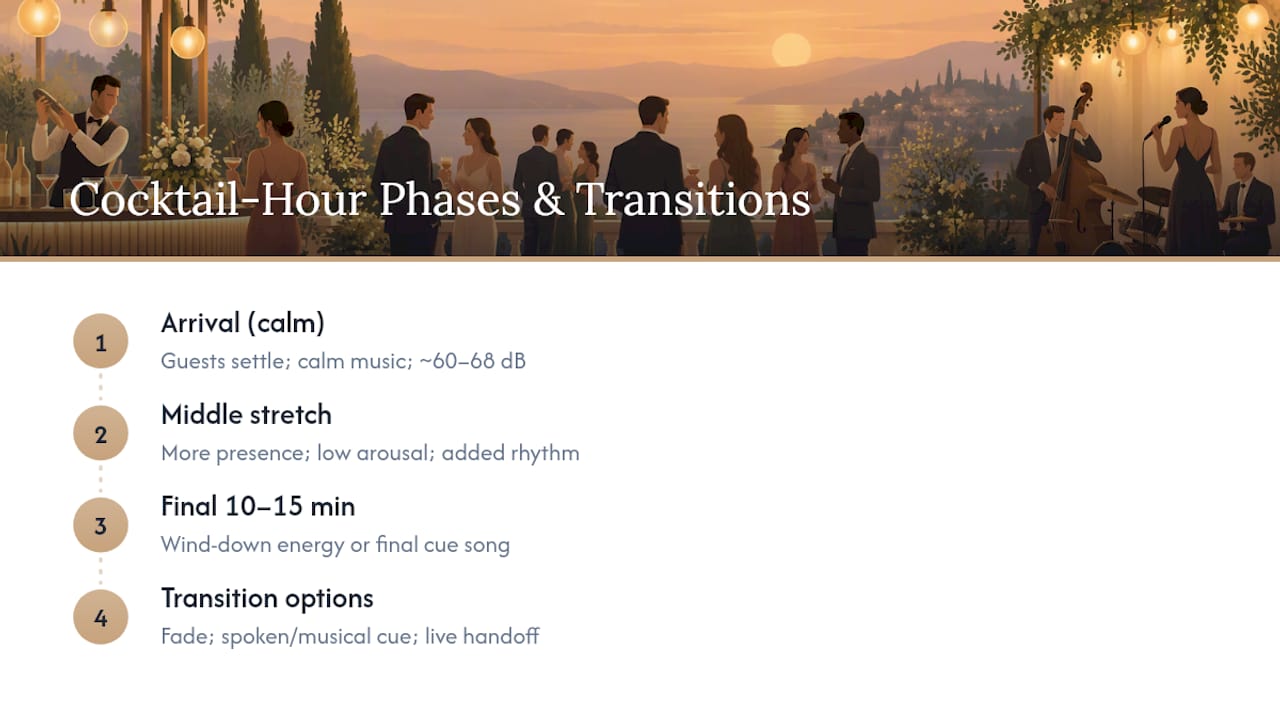
For that transition, you've got three options: a gradual fade in tempo and volume, a spoken or musical cue announcing the room change, or a live handoff where the cocktail ensemble segues directly into the entrance music for the reception. Live musicians handle this transition more smoothly than a fixed playlist, since they can read the room and stretch or cut material as needed.
How Many Songs Do You Actually Need?
Planning guides converge on a simple rule: expect roughly 15 to 20 songs per 60 minutes, depending on average track length. A 75 to 90 minute cocktail hour typically needs 20 to 25 songs. Always build in a 10 to 15 minute buffer, because photos run long and toasts get delayed more often than they don't.
A simple three-part structure keeps the set from feeling random:
- Opening (first 15 to 20 minutes): calmest songs, lowest energy, arrival mood.
- Middle (bulk of the hour): your core mood bucket, slightly more presence, the majority of your song count.
- Closing (final 10 to 15 minutes): wind-down songs or a clear signal track before the reception begins.
Setting Up Sound Equipment for Cocktail Hour
Sound setup for cocktail hour is different from reception setup, and treating it the same way is a common mistake. Reception sound systems are built for volume and bass; cocktail hour needs even coverage at low output, which is a different engineering problem.
If you're using speakers rather than live instruments, two smaller speakers placed at opposite ends of the space usually beat one large speaker at full volume in the center. Even coverage lets you keep the overall level lower while still reaching every corner of the room, which matters more outdoors where sound dissipates faster than most people expect.
Check power access before booking anything. Outdoor venues, gardens, and historic buildings often have limited outlets, and a musician or DJ arriving without a plan for extension cords or battery power can lose 20 minutes of setup time scrambling. Confirm with your venue coordinator whether they provide a sound system or expect the performer to bring one, since this gets assumed incorrectly more often than it should.
Wind and open air also change how sound behaves. A string quartet or acoustic setup that sounds perfectly balanced indoors may need repositioning outside, since acoustic instruments lose projection in open space faster than amplified ones. If your cocktail hour is outdoors, ask whoever handles your music to do a real soundcheck in that exact spot, not just a general system test elsewhere on the property.
Do You Need a License to Play Music at Your Wedding?
Licensing exists for public performance of music, but the rules differ depending on who's playing and where. If you hire live musicians, they typically handle any performance licensing themselves as part of running their business, since organizations like ASCAP, BMI, and SESAC license venues and performers for public performance in the United States, and equivalent bodies exist in other countries.
Private weddings held at a private residence generally fall outside public performance licensing requirements, since the audience is invited guests rather than the general public. Weddings at commercial venues, hotels, or event spaces are a different story: many venues already carry a blanket performance license covering recorded and live music played on their property, but this isn't universal, and it's worth confirming directly with your venue rather than assuming.
Streaming a personal playlist through a consumer account (Spotify, Apple Music) for a private event is generally treated differently than a business publicly broadcasting music, but terms of service vary by platform and country, and a DJ or vendor operating commercially may need their own licensing regardless of venue coverage. If you're unsure whether your specific venue and setup require anything beyond what your vendors already carry, ask your venue coordinator directly. It's a five-minute conversation that avoids a genuinely awkward problem later.
Musicaluxe's Perspective: What Live Ensembles Get Right
Recorded playlists are efficient, but they can't respond to a room. A live ensemble reads energy in real time, stretches a piece when photos run long, and adjusts dynamics as guests move from quiet arrival chatter to a fuller, louder middle stretch. Some bespoke music services develop sets tailored to each couple's vision rather than a fixed template, choosing instrumentation and pacing that suit the venue's acoustics as much as the couple's taste. Recorded music still has its place for tighter budgets or venues where live setup isn't practical. Where the room, the guest mix, and the moment call for something that breathes with the event, a live ensemble does what a playlist structurally can't.
— William
Book a Bespoke Cocktail Hour Ensemble
If you'd rather hand this off entirely, some services offer live ensemble performances that adjust to your venue and your timeline in the moment, rather than relying on a fixed playlist and speaker placement.
Certain classical music providers work with couples to build cocktail hour sets around soloists, duos, or small chamber groups, matched to venue size and desired mood rather than using a generic template. This fits weddings in acoustically distinct spaces (gardens, chapels, historic villas) where a fixed playlist tends to fall flat, and for couples who want live coordination with catering and photography timing rather than a set-it-and-forget-it approach. Browse past performances to see ensemble styles in action, then reach out through the booking page to request a sample setlist and get a quote tailored to your venue and timeline.
Sources
- Nature: study on background music and arousal (2026)
- Springer: background music arousal study (2025)
- Arnie Abrams: upscale wedding cocktail hour tips (practitioner guide)
- Sortra: practical guide to planning cocktail hour music
- The Knot: Should you have cocktail hour music? (editorial list and examples)
FAQ
Should There Be Music During Cocktail Hour?
Yes. Music fills the silence, gives guests something comfortable to talk over, and sets the tone before the reception begins. Skipping it usually leaves cocktail hour feeling flat or awkwardly quiet.
What Are Some Jazzy Songs That Work for Cocktail Hour?
"Feeling Good," "Autumn Leaves," "Fever," "Sway," and "Georgia on My Mind" all work well as jazzy lounge picks, especially in instrumental or acoustic arrangements. These suit indoor venues with a slightly formal feel, and a live jazz trio or pianist, like the ensembles Musicaluxe arranges, can shape them to the room.
How Many Songs Do You Need for a Cocktail Hour?
Plan on roughly 15 to 20 songs for a 60 minute cocktail hour, or 20 to 25 for 75 to 90 minutes, depending on average track length. Add a 10 to 15 minute buffer since photos and toasts commonly run behind schedule.
What Are Crowd-Pleaser Songs for a Wedding Cocktail Hour?
Crowd-pleasers are familiar songs most guests recognize regardless of age, like acoustic covers of "Perfect" or "Thinking Out Loud," or jazz standards like "Fly Me to the Moon." They work because recognizability creates comfort without requiring anyone to actually sing along.