
For an upscale wedding reception, hire a bespoke live classical ensemble sized to the venue and moment, not a DJ or a playlist. Wedding reception music at this level means a duo, trio, quartet, or small chamber orchestra chosen for your guest count and space, with repertoire and logistics worked out in advance. Exclusive classical music services can supply soloists through chamber orchestras across various regions and offer direct consultation.
TL;DR:
- Choosing the right ensemble size depends on guest count and venue acoustics, with a string quartet suitable for 75 to 200 guests under ideal conditions.
- Proper volume management involves soft music during dinner to support conversation and louder, dynamic pieces for key moments like the first dance or speeches.
- Contracts should clearly specify performance details, backup arrangements, and recording permissions, with special attention to rehearsals and amplification needs.
- Repertoire should blend recognizable classical pieces with thoughtfully arranged contemporary music that matches the couple's taste and the venue’s atmosphere.
- A bespoke service starts with a consultation that tailors ensemble size, repertoire, and timing, ensuring a cohesive, adaptable musical experience aligned with the event’s specific conditions.
Table of Contents
- Choosing the Right Ensemble for Each Reception Moment
- Reception Timing Templates: From Prelude to Last Dance
- What to Confirm Before You Book: Logistics and the Contract
- Repertoire That Elevates a Reception
- An Editor's Perspective on Booking Bespoke Musicians
- Matching Music Genres to the Couple and the Guest List
- Working In Requested Songs and Dedications
- Coordinating With a DJ or Other Entertainment
- Honoring Cultural and Religious Music Traditions
- Managing Volume Across the Reception
- Why the Conventional Advice on Reception Music Falls Short
- How Musica Luxe Turns This Guide Into Your Reception
- Sources
- FAQ
Choosing the Right Ensemble for Each Reception Moment
Guest count and venue size decide almost everything about instrumentation. A duo works for gatherings under about 50 people. A trio suits 50 to 120 guests. A string quartet is the standard baseline for formal receptions of 75 to 200, and it remains the go-to choice for most upscale events because it delivers four-part harmony a trio simply cannot. Beyond 200 guests, or in a large ballroom with poor acoustics, you need a sextet or a small chamber orchestra, often with light amplification.
The mistake most planners make is assuming bigger always sounds better. It doesn't. A quintet in a 40-person garden ceremony can feel like overkill, while a lone violinist in a 300-person hall simply disappears into the room. Matching scale to moment matters more than maximizing headcount.
- Prelude and cocktail hour: duo or trio, unamplified in most indoor spaces
- Plated dinner: trio or quartet, kept deliberately soft
- First dance and headline moments: quartet or larger, sometimes with a soloist stepping forward
- Outdoor or tented receptions over 150 guests: quartet plus subtle amplification
Pro Tip: Before you book, send your provider the guest count, venue floor plan, sightlines, and available power outlets. A five-minute checklist call saves a same-day scramble over where the cellist sits.
Reception Timing Templates: From Prelude to Last Dance
A reception runs on cues, not just song titles. Musicians typically block the day into five phases, each with its own volume and tempo logic, following the structure most experienced string ensembles use to keep music supportive rather than distracting.
- Prelude (15 to 30 minutes): ambient, unobtrusive pieces while guests arrive
- Processional and interlude: short, cued pieces timed to walking pace, not song length
- Cocktail hour (60 to 90 minutes): livelier repertoire, moderate volume
- Dinner rotation (90 to 120 minutes): lowest volume of the day, built to support conversation and let servers work without shouting over a melody
- First dance and spotlight moments: full dynamic range, often the loudest and most rehearsed moment of the set
Musicians usually take cues from a stage manager or the MC through hand signals or a quiet nod, not a shouted instruction across the room. Practitioners recommend shaping dynamics deliberately: soften for toasts and kitchen service, then build a short crescendo into a grand entrance or first dance to mark the shift in energy.
What to Confirm Before You Book: Logistics and the Contract
Get everything in writing. The Institute of Musical Performance's contract guidance for hired musicians lists the non-negotiables: exact venue, date, and performance times; total fees and expenses; what repertoire will be performed; rehearsal arrangements; and recording permissions.
That last item trips up more couples than any other. Recording or livestreaming a performance without prior agreement can trigger additional fees or a flat refusal, since musicians commonly charge extra when a set will be recorded or broadcast. Settle it before the day, not during the toasts.
A solid contract, modeled on ISM's sample performance agreement, should also cover:
- Rehearsal schedule and who bears the cost if extra rehearsal is needed
- Cancellation and illness policy, including who finds a substitute
- Overtime and travel expense terms if the reception runs long
- Amplification and power needs, and who supplies front-of-house sound
- A named backup musician or ensemble with a defined notice period
That backup clause deserves real attention. A named substitute with a clear notice window, and a stated remedy such as a fee reduction if the substitute falls short, protects you far better than a vague "we'll handle it" promise. Clarifying intellectual property and recording expectations in the contract also heads off disputes that WIPO's guidance on music rights flags as a recurring source of post-event friction.
Repertoire That Elevates a Reception
The right playlist mixes recognizable classical staples with contemporary pieces arranged to keep a classical tone. A gigging musician writing for WFMT makes a strong case for skipping the standard march-heavy lineup in favor of pieces with more emotional range.
- Prelude: Bach's Air on the G String, or something quieter like a solo cello prelude
- Processional: Pachelbel's Canon in D remains reliable, but Delibes' "Flower Duet" arranged for strings is a genuinely underused alternative
- Cocktail hour: Borodin's "Notturno" or Liszt's "Liebesträume" give guests something warmer than background filler
- Dinner: softer chamber works, string arrangements of jazz standards, or a solo piano set if the room calls for something more intimate
- First dance: whatever song matters to the couple, arranged for the ensemble on hand
Solo piano suits intimate dinners under roughly 60 guests better than a full quartet, which can feel oversized in a small room. Strings-only ensembles handle outdoor ceremonies and cocktail hours well, while a chamber arrangement, adding a flute or clarinet to the string core, gives dinner service more color without pushing volume up.
Arranging a contemporary song for strings takes real craft. The goal is keeping the original melody's shape while turning any percussive groove into bowed or pizzicato figures, so the result sounds refined rather than like a novelty cover.
An Editor's Perspective on Booking Bespoke Musicians
Bespoke music service providers often work with clients through direct consultation, matching repertoire and ensemble size to the venue, lighting, and ceremony schedule rather than handing over a fixed catalog. That conversation, not the instrument list, is what actually shapes how the day sounds. A cellist can shift a piece's tempo by a beat or two to land a processional exactly as the bride enters, something no pre-recorded track can do.
When reviewing a provider's past event photos, look past the instruments themselves. Check the staging: where musicians sit relative to guests, how seating handles sightlines, and whether the ensemble size in the photo actually matches the room shown. A quartet photographed in a cavernous hall tells you less than one shown in a room close to your own venue's scale.
Matching Music Genres to the Couple and the Guest List
The best reception soundtracks reflect who is actually in the room, not a generic "wedding music" template. Before finalizing a setlist, think through two questions: what does the couple actually love, and who is sitting at those tables?
If the couple met through a shared love of jazz, a string ensemble can lean into jazz standards arranged for quartet rather than sticking rigidly to Baroque staples. If grandparents make up a large share of the guest list, keep tempos and volume gentler through dinner, then let the energy rise once the formal moments wrap up. A crowd skewing younger might welcome a contemporary arrangement worked into the cocktail hour, while a more traditional gathering may prefer the ensemble stay closer to recognizable classical repertoire throughout.
The venue itself often settles the tone. A restored chateau or a formal ballroom calls for a different musical register than a vineyard terrace or a beach club reception. Bring your ensemble examples of the couple's favorite artists or songs during the consultation. A skilled arranger can translate almost any genre, pop, film scores, even electronic music, into something a string quartet or chamber group can perform convincingly. The point isn't forcing guests into one mold. It's finding the overlap between what the couple loves and what will land with the people who came to celebrate them.
Working In Requested Songs and Dedications
Special requests are where a bespoke ensemble earns its fee. Whether it's a parent's favorite song for a dedication dance or a piece that means something specific to the couple, the key is telling your musicians early, not the week of the wedding.
Give the ensemble the song title, the moment it belongs to, and any specific memory attached to it, at least a few weeks out. That lead time lets an arranger score the piece properly for the instruments you've booked, rather than rushing a rough version. If the requested song has lyrics tied to a meaningful line, ask the musicians to build a small pause or dynamic swell around that phrase. It reads as intentional, not accidental.
Dedications tend to work best with a slight change in instrumentation, a solo violin stepping forward from the quartet, for instance, to visually and sonically separate the moment from the rest of the reception. Confirm during your consultation whether the piece needs full written arrangement or whether the ensemble can work from a lead sheet. Complex requests, especially anything with an unusual time signature or heavy vocal-style phrasing, need more preparation time than a straightforward classical piece.
Coordinating With a DJ or Other Entertainment
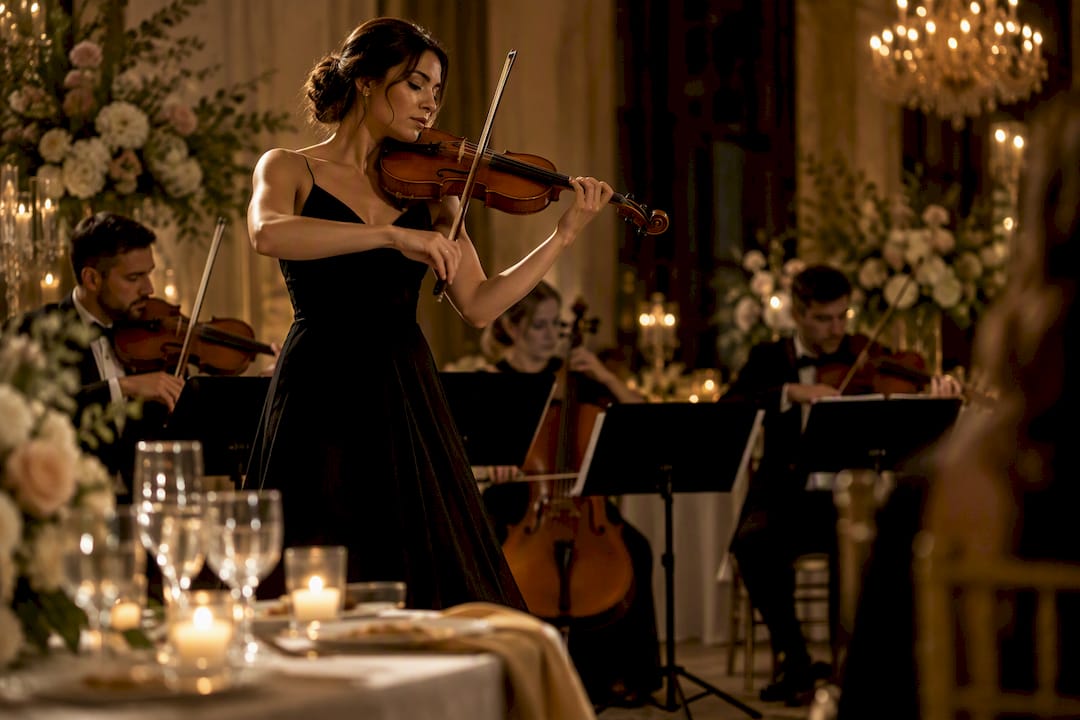
Many upscale receptions run a classical ensemble through dinner and speeches, then hand off to a DJ or band for dancing later in the night. That handoff is where receptions either flow or stall.
Set a specific transition time in writing, not an approximate one, so both acts know exactly when to start and stop. Give the ensemble a firm end point, ideally five to ten minutes before the DJ's setup needs to begin, so there's no dead air while equipment gets swapped. If both acts will share a stage or the same power source, have them coordinate on amplification needs ahead of time rather than discovering a conflict on the day.
A brief overlap can work beautifully. Some receptions have the string ensemble play a final, quieter number while the DJ's booth quietly comes online, creating a soft bridge instead of an abrupt cut. Loop your planner or MC in on the schedule so they can cue both acts. Musicians who have handled these handoffs before will usually flag potential timing conflicts themselves if you ask directly during booking.
Honoring Cultural and Religious Music Traditions
Cultural and religious elements often carry more weight at a reception than any other musical choice, so treat them as a planning priority, not an afterthought. If a ceremony or reception includes specific ritual music, whether a processional tied to religious tradition or a folk piece tied to family heritage, tell your ensemble during the initial consultation, not the week before.
Some traditional pieces exist in published arrangements for string ensemble or chamber group; others may only exist as vocal or recorded versions that need a custom transcription. Ask your provider directly whether they can arrange the piece themselves or whether they'll need extra lead time to source sheet music. A reputable ensemble will tell you honestly if a request falls outside standard classical instrumentation, rather than improvising something that misses the mark.
If multiple cultural traditions are represented across the couple's families, build a short segment into the reception, perhaps during cocktail hour, dedicated to that music rather than blending it awkwardly into the standard set. It gives the moment its own space and signals to guests that it matters. Confirm pronunciation of any titles or names tied to the piece, and make sure the ensemble understands the moment's significance, not just its notes.
Managing Volume Across the Reception
Volume needs shift constantly across a reception, and getting it wrong in either direction, too loud during dinner, too quiet during a first dance, undercuts the whole atmosphere. The general rule: volume should support conversation, not compete with it, except during moments explicitly designed to hold everyone's attention.
During cocktail hour, music can sit at a moderate, lively level since guests are mingling and don't need to hear every word from across the room. Once dinner service starts, volume needs to drop noticeably so servers can take orders and tables can talk without raising their voices. First dances and toasts flip that logic entirely. Volume should rise to fill the room and hold focus, since that's the one moment guests are meant to watch rather than talk over.
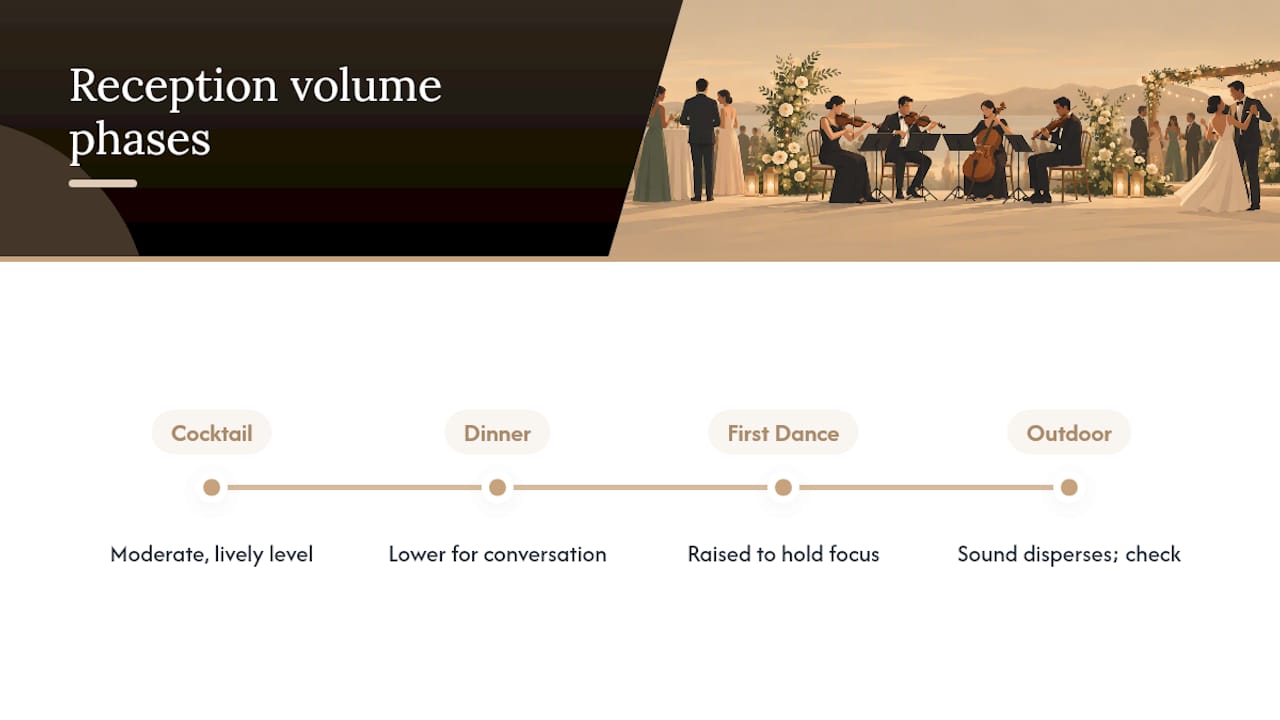
Outdoor and tented receptions complicate this further. Sound disperses differently outside, so what feels appropriately quiet indoors can vanish entirely in open air, which is often the actual reason light amplification gets added even for smaller ensembles. Ask your provider to walk the venue in advance if possible, checking how sound carries at cocktail distance, dinner-table distance, and dance-floor distance. A quick sound check an hour before guests arrive catches problems no amount of planning on paper will reveal.
Why the Conventional Advice on Reception Music Falls Short
Most wedding guides treat music as a checklist item: pick songs, book a vendor, move on. That framing undersells how much a reception's atmosphere depends on musicians who can read a room in real time, not just play from a set list. The couples who get this right treat the ensemble less like entertainment and more like a collaborator in pacing the entire event.
The biggest gap I see is planners underinvesting in the contract and rehearsal conversation while overinvesting in song selection. A gorgeous setlist means little if nobody clarified overtime rates or what happens if a violinist gets sick. Prioritize the unglamorous logistics first: contract terms, backup arrangements, and a clear timing template. Repertoire choices matter, but they're the easier problem to solve once the structural pieces are locked down. Bigger isn't better either. A ballroom-scaled ensemble crammed into an intimate garden ceremony does more harm than good, and no amount of talent fixes a mismatch in scale.
— William
How Musica Luxe Turns This Guide Into Your Reception
Using a bespoke music service offers an alternative to booking a generic wedding band from a vendor list. Instead of choosing from a fixed package, clients may work through direct consultation to build an ensemble, from a single soloist to a full chamber orchestra, matched precisely to the venue, guest count, and important moments.
The process typically starts with a consultation covering venue, timeline, and musical preferences. From there, a bespoke quote and a sample setlist mapped to the reception's phases, from prelude through first dance, can be provided, so clients can preview the event's sound before confirming. Musicians often have genuine concert experience rather than being chosen only for appearance.
If you're ready to start planning, visit the Musica Luxe landing page to see the full range of services, browse the event gallery for staging and ensemble examples, or head straight to book a consultation and get your bespoke quote underway.
Sources
For contract language, the ISM's performance contract guide and its accompanying sample agreement remain the standard reference. For ensemble sizing and repertoire ideas, see Shindig's string ensemble guide, WFMT's repertoire piece, and Lupa Entertainment's planning guide.
- Contracts for Musicians | Advice & Templates | ISM
- Underrated classical music for weddings (gigging musician) — WFMT
FAQ
How Many Musicians Do I Need for 100 Guests?
A string quartet is the standard baseline for formal receptions, offering fuller harmony than a trio without the footprint of a larger ensemble. Venue acoustics and layout can shift that recommendation, so confirm sizing during a consultation before booking.
Can a Classical Ensemble Play Outdoors Without Amplification?
Small ensembles can play unamplified outdoors for intimate gatherings, but sound disperses quickly in open air, so light amplification is often added even for a quartet once guest counts climb past 150. A venue walkthrough before the event settles whether amplification is needed.
What Should Be in a Musician's Performance Contract?
A solid contract specifies performance times, fees and expenses, the repertoire to be performed, rehearsal arrangements, and recording permissions, following the essentials laid out in ISM's contract guidance. It should also name a backup musician and define notice periods for cancellations.
How Much Rehearsal Time Do Wedding Musicians Need?
Rehearsal needs depend on repertoire complexity, straightforward classical pieces need little beyond a run-through, while custom arrangements of contemporary songs or cultural pieces require more preparation. Discuss rehearsal scope directly with your ensemble and confirm it in the contract.
Does Musica Luxe Provide Custom Arrangements?
Yes, Musica Luxe works through direct consultation to arrange both classical repertoire and contemporary songs for the ensemble a client books. Pricing for these services is available on request through the Musica Luxe site.