
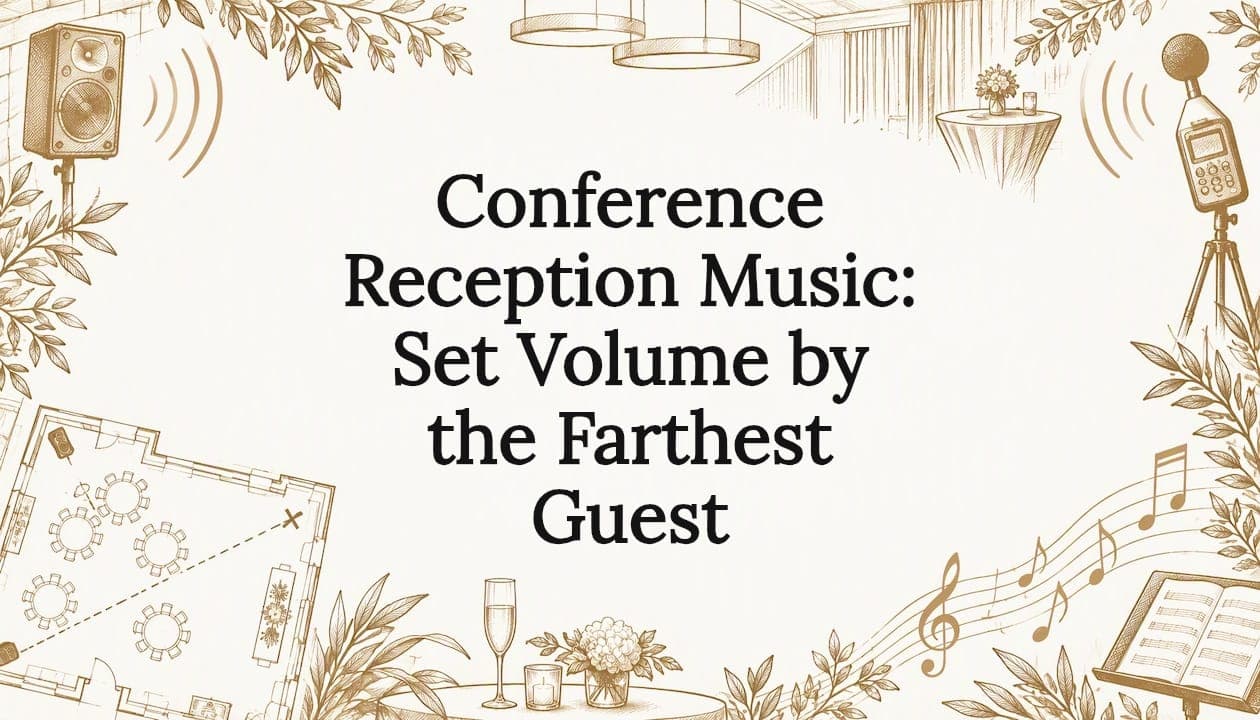
A dependable approach to conference reception music is a low-volume, instrumental live set, or a professionally mixed recorded bed when live is impractical, built to protect conversation and grow with the room. Choose a versatile ensemble such as a jazz trio or string quartet, brief your AV team early, and plan a deliberate volume ramp as attendance builds.
TL;DR:
- Choose a soloist or duo for foyers and intimate dinners, a trio or quartet for many hotel ballrooms, and chamber players for large spaces.
- Set levels from the farthest guest, begin quietly, and raise sound as attendance grows; keep speakers away from bars and registration desks.
- Choose live music for a signature reception when the venue can host performers; recorded music suits short arrival windows, corridors, and rooms without a stage.
- Give musicians and AV staff one cue sheet covering volume changes, repertoire phases, announcement dips, and transitions, with one contact signaling each change.
- Use instrumental versions of familiar songs when generations or cultures vary, since lyrics can pull attention from conversation even when the volume stays low.
Table of Contents
- What are the best music styles for a conference reception?
- Which songs and playlists work for arrivals and networking?
- How big should the ensemble be for your room?
- How do you set up volume, placement and timing?
- How does music actually help people network?
- What do real conferences show about live music?
- Why three decisions matter more than the song list
- How Musica Luxe can help with your reception
- FAQ
- Sources
What are the best music styles for a conference reception?
Your reception has one job: help strangers start conversations. The style you choose should sit underneath that job, never on top of it. These are some options to consider:
- Light jazz: Familiar, warm and flexible. A jazz group can shift from quiet networking sets to livelier material as the room fills, which keeps the whole evening cohesive.
- Instrumental soul: Smooth grooves with no lyrics competing for attention. A good fit for creative, tech or consumer-facing audiences.
- Lounge: Soft, rhythmic and modern. Works well from a recorded bed when the budget is tight.
- Acoustic singer-songwriter: Intimate and approachable. DevFest Modena's acoustic concert reworked a band's repertoire for an intimate evening inside a conference, which is the same idea at a smaller scale.
- Classical chamber: Strings, piano or a small ensemble signal polish. This suits galas, finance, law, healthcare and any brand that wants to look composed.
Live versus recorded comes down to three questions. What do attendees expect? Does the venue have the space and power for performers? And what can the budget carry? Live music gives the room a focal point and a sense of occasion, and conferences routinely build their evening programs around it, as in the CTI Global Sales Meeting's sponsored live concert. A recorded bed makes sense for a short arrival window, a hotel corridor or a room with no stage.
Match the style to your audience and your brand. A younger developer crowd will enjoy acoustic reworkings of songs they know. A board-level dinner will respond to refined strings. When your guests span generations and cultures, instrumental material with wide familiarity keeps everyone comfortable.
Which songs and playlists work for arrivals and networking?
Think in mood buckets, then fill each with tracks that suit your audience. Lyrics are fine at low volume, but instrumental versions are safer because words pull attention away from the person in front of you.
Here are some mood buckets with exemplar ideas:
- Welcoming mellow: "Fly Me to the Moon," "The Girl from Ipanema," "Moon River," "Autumn Leaves," "What a Wonderful World," "Misty," "Blue in Green," "Our Love Is Here to Stay."
- Upbeat but low-key: "Sunny," "Isn't She Lovely," "Better Together," "Put Your Records On," "Lovely Day," "Valerie," "Overjoyed," "Don't Know Why."
- Sophisticated classical: Pachelbel's Canon, Vivaldi's "Spring," Debussy's "Clair de Lune," Mozart's "Eine kleine Nachtmusik," Satie's Gymnopédie No. 1, Bach's "Air on the G String," Fauré's "Pavane."
- Modern instrumental: String or piano arrangements of current pop and indie hits, plus vibraphone and guitar covers of familiar chart songs.
Popular songs transform well for a formal room. A pop ballad arranged for a string quartet or solo piano keeps the recognition factor while removing the vocal and softening the dynamics. That small trick gives guests the pleasure of "I know this one" without anyone having to shout over it.
Use these running orders as templates:
- Small reception: Welcoming mellow throughout, with an upbeat track near the end to signal the shift to the program.
- Medium reception: Open with mellow, move to upbeat low-key as the room fills, and finish with a modern instrumental closer.
- Large reception: Start with sophisticated classical or mellow, layer in upbeat tracks, and keep a clear final track ready for transitions into speeches.
For more arrival-specific repertoire, our reception entrance music picks include a briefing template you can hand straight to a performer. If you want mood playlists organized by the hour, our cocktail hour guide covers that ground.
How big should the ensemble be for your room?
Match the ensemble to the room, not the budget fantasy. A big group in a small room forces the volume up, and then nobody can talk. These rules of thumb hold up across most venues:
- Solo or duo: A pianist, guitarist or violin and piano pairing. Ideal for foyers, boardroom receptions and intimate dinners.
- Trio or quartet: Jazz trio, string quartet or piano with bass and drums played softly. This can suit many hotel ballroom receptions.
- Small chamber ensemble: Add instruments such as violin, viola, cello or soft woodwinds to give the sound enough body for a large space without extra amplification.
Some instrument combinations mask speech less than others. Strings, piano, acoustic guitar and soft woodwinds sit comfortably under conversation. Drums, brass and heavily amplified vocals tend to push the room volume upward, so keep them out of the early window or play them with restraint.
Good ensembles can also expand or contract during the evening. A quartet might begin as a duo while early guests arrive, then add players as the room fills. Brief your musicians on this plan in advance, including who plays when, which tracks anchor each phase and what the cue is to step up or down.
How do you set up volume, placement and timing?
Setup is where good music plans usually fail. Walk through this checklist with your AV team:
- Set volume from the farthest guest point. Stand at the spot in the room farthest from the speakers, not at the sound desk, and adjust until you can hold a normal conversation there. The goal is a bed of sound that gives guests privacy, not a performance they must listen to.
- Start lower than you think. Early arrivals fill a room with silence, so a low level already feels present. Raise it gradually as attendance grows rather than setting it for a full room at the start.
- Place speakers to cover evenly. Several smaller speakers spread around the space beat a couple of loud ones at the front. Keep speakers away from the registration desk and bars, where staff need to be heard.
- Do a simple soundcheck. Test the quietest and loudest passages of the repertoire, check for feedback near microphones, and confirm performers have a monitor or a clear line of sight to a sound tech.
- Agree on cues. Define when the music ramps, when it dips for announcements and when it stops. A planner or stage manager should hold the cue sheet, with a single point of contact for the band and AV.
- Plan transitions. Whether moving from reception to dinner or into speeches, decide in advance how the music fades, who signals it and what plays during gaps.
Venue acoustics can matter to planners. A 2026 proceedings paper on live performance spaces found that acoustic qualities and framing influence audience connection and how people perceive and interact with a space. Hard surfaces and high ceilings reflect sound, so a room that feels fine when empty can become loud when full.
How does music actually help people network?
Music helps in three concrete ways. First, it gives conversational privacy: a gentle bed of sound masks the awkward silence between two people who have just met, so they feel less overheard and more willing to talk. Event sound specialists often judge a networking reception by how many conversations start, and music supports that goal by staying in the background.

Second, music cues movement and energy. Slightly livelier material draws people toward a bar or the main space, while quieter passages invite them to settle into smaller groups. Some events go further and dedicate separate areas to different intensities. Crossroads, an Artia Solutions conference, pairs main live-music areas with quieter spaces such as rooftops so attendees can choose how social to be.
Third, music affects mood. Harvard Health points to music's general cognitive and emotional benefits for the brain, which is why a well-chosen soundtrack can make a room feel more relaxed and welcoming.
Finally, a bespoke theme or short anthem can reinforce your brand. It gives attendees something to remember and hum on the way home.
What do real conferences show about live music?
The strongest evidence comes from events that have already tested these ideas:
- SongDivision: The group reports that custom songs and evolving formats turn music into a branding tool that drives engagement beyond the conference. In its multi-day conference work, the format grows daily, starting small and building to larger shared musical moments that sustain attendee engagement.
- Club Framery: The Music Trust's activation at NeoCon 2026 shows how live music and coordinated AV shaped pacing from arrival to high-energy moments, through planned performer mix and timing.
- Jammin'4Water: The WEFTEC welcome reception uses live music to build community, encourage informal performance from attendees and spark connections.
- Welcome receptions generally: The National Urban League's Host Night Celebration uses live entertainment and local music to welcome attendees and show off local culture.
The common thread is planning: someone decided what the music was for, then built the schedule and AV around it.
Why three decisions matter more than the song list
Most planners obsess over repertoire and underinvest in the details that decide whether music works. The song list is the easy part. What separates a reception where people talk from one where they shout is whether someone owned the volume and the timeline.
Here are the non-negotiables I would put at the top of any brief:
- Supportive volume: Set from the farthest guest, ramped with attendance.
- Repertoire versatility: Material that works quietly and can lift when needed.
- AV and timeline coordination: One cue sheet, one point of contact.
For your proposal or RFP, ask vendors for ensemble options, a sample set list, their volume approach and their plan for transitions. As a decision rule, hire live when the reception is a signature moment, the room can host performers and the audience will notice the difference. Use a recorded bed for short windows, tight rooms or tight budgets.
— William
How Musica Luxe can help with your reception
We offer a bespoke classical music service for events on the Côte d'Azur and in Provence. Our process starts with a conversation: we learn your room, your guests and your program, then recommend the ensemble that fits, from a soloist to a chamber group, with repertoire arranged around your event. That includes custom arrangements of any genre, so a modern favorite can become a string quartet piece.
To get started, tell us your date, venue and guest count through our service page, and we will return a tailored quote.
FAQ
What type of music is best for a conference reception?
Low-volume instrumental music works best, such as light jazz, acoustic or chamber strings. It stays under conversation and gives guests privacy to talk. The right choice depends on your audience and brand.
How loud should reception music be?
Loud enough to be present, quiet enough that people at the farthest point from the speakers can talk normally. Set it from that spot rather than at the sound desk, and raise it gradually as the room fills.
Is live or recorded music better for networking?
Live music gives a reception a focal point and a sense of occasion, so it suits signature moments. Recorded beds work for short windows or small rooms. Either one succeeds when it stays under conversation.
What are good songs to start a meeting or reception?
Choose familiar, mid-tempo tracks like "Sunny," "Lovely Day" or "Fly Me to the Moon," preferably in instrumental arrangements. They set a warm tone without competing with introductions.