
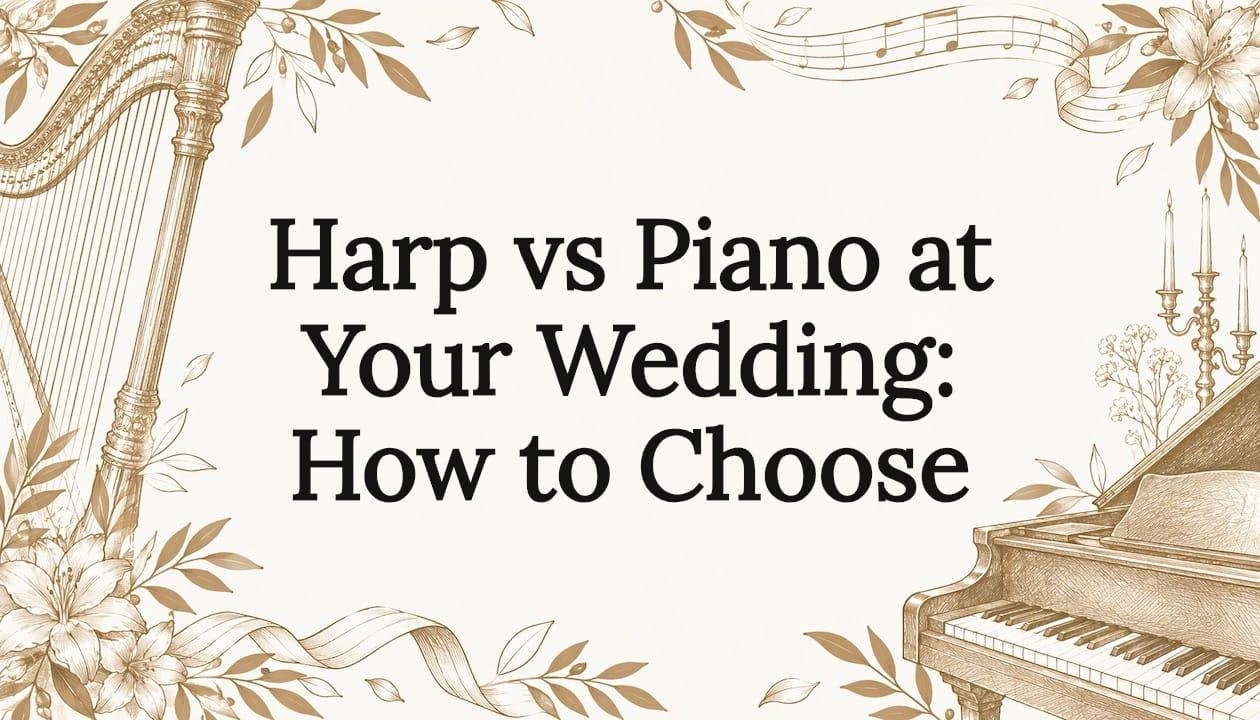
Choose the harp when you want a shimmering, airy sound in a garden, chapel or terrace where you can bring an instrument in easily. Choose the piano when the venue already has a good one, when you want warmth and emotional range, or when the program leans on pop and film songs. Either instrument is only as good as the person playing it, so the more important decision is hiring a classically trained musician with real concert experience. We arrange exactly that on the Côte d'Azur and in Provence, and the guidance below applies to any wedding.
TL;DR
- The harp gives a light, flowing, fairytale sound that suits outdoor and romantic settings. The piano gives intimacy, depth and dramatic range.
- The venue often decides for you. A harp travels to almost any room, but needs shade, level ground and stable weather. A piano needs an instrument that is already there, in tune, or an electric stand-in.
- In the US, ceremony-only harpists are reported at $400 to $1,200 and solo pianists at $300 to $600 (2026).
- A harp-and-piano pairing, or a harp with a violin, often beats choosing one.
- Ask for a live audition recording, a repertoire list and concert credentials. Looks and a backing track are no substitute for training.
Table of Contents
- How the two instruments sound in a wedding setting
- Matching the instrument to the moment
- Venue logistics: where the real decision is often made
- What it costs in the US in 2026
- Why not just choose both?
- A quick decision guide
- How to make sure the musician is the real thing
- Our perspective
- Bring live classical music to your wedding
- FAQ
- Sources
How the two instruments sound in a wedding setting
The harp is a plucked, resonant instrument. Each note blooms and fades, so a flowing arpeggio fills a room without pushing. That is why it has long been associated with processionals, cocktail hours and anything that should feel suspended in time. It sits comfortably underneath conversation, which matters when guests are arriving and mingling.
The piano is a struck instrument with a far wider dynamic and tonal range. A good pianist can play a whisper-quiet prelude and a full-chested recessional on the same bench. The piano is also the instrument most couples already associate with the songs they love, from Debussy and Satie to a ballad arranged for solo keys.
A simple way to think about it:
- Harp: airy, shimmering, graceful. Best when the mood is dreamlike, romantic or natural.
- Piano: warm, tactile, expressive. Best when the mood is intimate, emotional or stately, and when you want a wide range of repertoire.
Neither is more "classical" than the other. Both have centuries of solo repertoire, and both can be arranged to play almost any song you can name. If you would like your first dance song or a favorite film theme in a classical voice, a bespoke arrangement is the way to do it, and either instrument can carry it.
Matching the instrument to the moment
A wedding ceremony is a sequence of short moments, each with its own job. A ceremony music guide suggests quiet, flowing instrumental music for pauses such as candle lighting, sand ceremonies, handfasting and memorial tributes, and brighter, joyful music for the recessional. That split maps neatly onto the two instruments.
Prelude and guest seating
Both work. The harp creates calm as guests settle, which also helps the wedding party's nerves. A piano prelude feels more like a recital and invites a slightly more formal mood. If you plan five to ten pieces, our wedding music timeline shows how to space them and build the cue sheet.
The bridal entrance
The harp is the classic choice for a floating, unhurried walk down the aisle, especially for a slow, lyrical piece. The piano is excellent when you want a clear, steady pulse for a stately entrance, or a build to a crescendo as the doors open. We cover timing and repertoire in bridal entrance songs.
Ritual pauses
Unity candles, hand-fasting, a reading or a remembrance: the harp's soft decay leaves space for words. A piano can do this beautifully too, with a sparser, more reflective touch. For ceremonies without religious elements, see our ideas for non-religious ceremony music.
The recessional
Here the piano usually has the edge, because it can deliver volume, rhythm and exuberance. A harp recessional works if you want a gentle, glittering exit rather than a fanfare. Our recessional song guide has short 60 to 90 second options for each mood.
Cocktail hour and dinner
Both instruments are traditional. The harp blends into conversation; the piano can lift the energy with jazz-tinged or popular repertoire. Pairing the music with a refined menu matters too, and elegant cocktail reception menus show how a reception can be planned around a relaxed hour of music. For repertoire, see our cocktail hour music guide.
Venue logistics: where the real decision is often made
Couples choose by sound, then discover the venue has its own view. Check these before you commit.
Harp logistics
A concert pedal harp is tall and heavy. One harp specialist notes that pedal harps can weigh up to 40 kg and are hard to carry without a dolly, so the route in matters: stairs, narrow corners, gravel paths and elevators all need to be considered. Share the venue's access details with your musician early.
The harp is also a wooden instrument held in tension, so it dislikes direct sun, damp grass and sudden temperature swings. For an outdoor ceremony, plan for:
- A shaded, level, stable spot for the instrument.
- A covered backup space if the weather turns.
- Time before the ceremony for the harpist to tune in the actual conditions.
On the Riviera and in Provence, where summer ceremonies are often held on terraces and in gardens, we plan the shade and the backup layout with the venue well ahead of the day.
Piano logistics
If the venue owns a piano, the key question is its condition. A grand piano on site can be a wonderful asset, but only if it is tuned and well maintained. If there is no instrument, a quality digital or stage piano is the practical solution, though it sounds different from an acoustic grand and needs amplification.
As a concrete example of what a piano can involve, one US museum's wedding technical guidelines from 2022 list a baby grand with a $225 rental fee that includes tuning, plus a required audiovisual technician at $45 per hour with a four-hour minimum. Your venue's numbers will differ, but the pattern holds: house pianos, tuning and technical staff can add line items that never appear in a musician's fee.

Amplification and acoustics
A harp is quiet in a big, open or noisy space, so a discreet microphone or pickup may be needed for an outdoor or large-room ceremony. A piano projects more in a resonant room, and can overwhelm a small one. A short soundcheck settles both, and it is worth building into the schedule.
What it costs in the US in 2026
Prices vary by region, duration and repertoire. A 2026 US guide from a wedding stationery company reports the following ranges, ceremony only versus ceremony plus cocktail hour:
| Musician | Ceremony only | Ceremony plus cocktail hour |
|---|---|---|
| Harpist | $400 to $1,200 | $700 to $2,000 |
| Solo pianist | $300 to $600 | $500 to $1,000 |
The gap reflects the harp's transport demands and its more specialized, smaller talent pool. It is also true that those ranges describe the broad market. The price depends on:
- Level of training and experience. A conservatory-trained soloist with concert credits costs more than a hobbyist, and the difference is audible.
- Travel and setup. Remote venues, stairs, long drives and early load-ins all add to a quote.
- Repertoire. Learning a custom arrangement of your song takes rehearsal time.
- Duration and number of moments. Ceremony only is cheaper than ceremony, cocktail hour and dinner.
- Equipment. Amplification, a stage piano or a house piano's tuning all carry costs.
For a fuller picture of how budgets change between ensembles, our live wedding music cost guide compares US and UK figures. Every Musica Luxe engagement is custom quoted to your event, so we give you a figure only after we know your venue, timeline and the music you want.
Why not just choose both?
Many of the most memorable weddings use the instruments together or add a third voice. A harp and piano can split the day: harp for the prelude and aisle, piano for the recessional and reception. A harp and violin duo adds a singing melodic line on top of the harp's harmonic bed, and we describe the sound and the booking details in our harp and violin duo guide.

For small gatherings, a single instrument is often enough. Our notes on intimate wedding music explain how to scale the music to the guest list. Larger celebrations can step up to a quartet or a chamber ensemble, and the music plan stays the same: one musical idea for each moment.
A quick decision guide
| If your wedding is... | Lean toward |
|---|---|
| An outdoor garden or terrace ceremony in mild weather | Harp, with shade and a backup plan |
| In a chapel, villa or hall with a good piano | Piano |
| Romantic, dreamy or fairytale in tone | Harp |
| Formal, dramatic or emotional with a big finish | Piano |
| Heavy on pop, jazz or film songs | Piano, or a bespoke arrangement for either |
| A multi-stage day (ceremony, cocktails, dinner) | Harp and piano, or a harp and violin duo |
| Remote, with stairs or difficult access | Piano on site or a more portable ensemble |
How to make sure the musician is the real thing
The instrument matters less than who plays it. Many couples have seen a ceremony where attractive performers mime or play over a backing track. If you care about the sound, take these steps:
- Ask who exactly will play. You want the named musician, not a substitute from a roster.
- Ask about training. Conservatory or university music degrees and professional concert experience are the markers of a serious player.
- Listen to live, unedited recordings. A polished video with added audio tells you little.
- Confirm it is fully live. No backing tracks, no playback.
- Share your repertoire early. Learning a new piece well takes time, so a request for a custom arrangement should be made months ahead.
- Plan the cues. The musician should know your timeline and who gives the signal.
We handle this by working directly with you on the music and by engaging only classically trained professional musicians with concert experience. You can see our work in the gallery.
Our perspective
Couples often come to us asking whether the harp or the piano is the "right" instrument. In our experience of designing music for weddings, the answer starts with the room and the moment, then moves quickly to the musician.
A harp played by a trained concert musician is unforgettable. The same harp played badly over a backing track is forgettable at best and embarrassing at worst. The same is true of a piano. What guests remember is how the music made the day feel.
That is why we work closely with each client to understand the vision first, then match the ensemble, from a soloist to a chamber orchestra, and the repertoire, from classical works to custom arrangements of any genre. We choose musicians for their ability to play, not for how they look in a photograph.
If you cannot decide between harp and piano, tell us about your venue and your favorite songs. We will propose what suits the day.
William
Bring live classical music to your wedding
Musica Luxe provides bespoke classical music for weddings, private events, yacht gatherings, galas and other occasions across the Côte d'Azur and Provence. We work directly with you, suggest the ensemble that suits your venue and vision, and quote your event individually. To begin, visit Musica Luxe and tell us about your day.
FAQ
Is a harp or a piano better for a wedding ceremony?
Neither is better in every case. The harp suits airy, romantic and outdoor ceremonies, while the piano suits formal rooms, dramatic moments and a wider range of songs. Start with your venue and the mood you want, then choose the instrument.
How much does a wedding harpist or pianist cost in the US?
A 2026 US guide reports $400 to $1,200 for a ceremony-only harpist and $300 to $600 for a ceremony-only solo pianist. Adding a cocktail hour raises those to $700 to $2,000 and $500 to $1,000. Our own engagements are custom quoted.
Can a harpist play at any wedding venue?
Usually, yes, but access matters. A pedal harp can weigh up to 40 kg, so stairs, uneven ground and weather need planning. Outdoors, give the harp shade, a level surface and a covered backup.
Can a pianist play at a venue without a piano?
Yes, with a quality digital or stage piano and amplification. The sound differs from an acoustic grand, so discuss it with the musician in advance. If the venue does own a piano, ask when it was last tuned.
Can harp and piano play together at one wedding?
Yes, and it works well when each takes different moments. A common plan is harp for the prelude and aisle, piano for the recessional and reception. A harp and violin duo is another elegant pairing.
Sources
- Wedding Ceremony Music Made Simple, Wedding File
- Transporting A Pedal Harp: Tips and Precautions
- Wedding Entertainment Technical Production Guidelines 2022, Frist Art Museum
- How Much Does Wedding Ceremony Music Cost? (2026 Guide), Paperlust