
The best music for a luxury brand event is music that fits the brand's identity, never competes with the product, and is played live by musicians whose quality guests can hear. Live performance adds texture and presence that a playlist cannot. It also gives you something a playlist never will: proof that the brand pays for real craft. This guide covers how music shapes a luxury guest's judgment, how to match sound to a brand, what to ask musicians before you book, and how to run music through a launch, a gala or a runway show.
TL;DR
- Guests use music as a cue to judge the quality of an experience they cannot otherwise measure, so the music has to match the brand.
- Live musicians add texture and can follow the flow of a show or room in a way a recorded track cannot.
- Vet musicians as a presenting arts organization would: live video, a press kit, a technical rider and a clear soundcheck plan.
- Brief the music early, set it to support the product or the clothes, and keep it consistent across every touchpoint.
- For private events under about 200 guests, a quartet is often the sharper choice over a full orchestra.
Table of Contents
- What music does at a luxury brand event
- Matching the music to the brand
- Live versus recorded music at a luxury event
- Fashion shows and product launches with live music
- Choosing the format: solo, quartet or orchestra
- How to vet musicians for real quality
- Perspective: what we look for
- Run of show: where music sits in the evening
- Choosing a venue that suits live music
- Working with Musica Luxe
- FAQ
- Sources
What music does at a luxury brand event
A luxury event sells something intangible: an impression. The invitation, the venue, the lighting and the hosts all send signals, and music is one of the strongest. Oxford Saïd Business School professor Rhonda Hadi explains in The Guardian's reporting on the background music industry that music is one of the cues customers use to judge the quality of an intangible experience. Congruent music helps a guest read an evening as authentic and valuable. Incongruent music does the reverse, quietly.
The effect runs past the evening itself. A 2025 study of the FNAC Live program describes music as a tool for emotional connection and community, and reports that tying music to brand values strengthened brand attachment, engagement and advocacy beyond a single transaction. For a luxury house, that is the real goal of an event: a guest who remembers the feeling and repeats the story.
Music also shapes how guests behave in the room. In a customer story from a German premium car brand's lounge, a persona-aligned soundscape made the space feel more polished, supported comfortable one-to-one conversations and masked neighboring chatter, which gave customers a sense of privacy. That story comes from a company that sells music programming, so read it as a single illustration, not a guarantee. Still, the mechanics are familiar to anyone who has hosted a reception: a well-judged sound bed lets people talk closely without feeling overheard.
For a wider look at how sound lifts celebrations and the people in them, see this piece on music, vibes and celebrations.
Matching the music to the brand
The first rule is congruence. A 2024 chapter on luxury shoppers and background music finds that music can influence luxury consumers emotionally, cognitively and behaviorally, and stresses that it must fit the brand, because unsuitable music can produce unfavorable outcomes. Expensive music that is wrong for the house is worse than modest music that is right.
The second rule is to choose a mood deliberately. The Marketing Society describes how luxury sectors often borrow named emotional territories, such as "Catwalk Cool," "Art Opening Eclectic" or "Classical Glamour", to signal exclusivity. Classical Glamour, orchestral and noble in character, is the territory where live strings, piano and voice live naturally. It suits heritage houses, jewelers, watchmakers, wine and spirits, private banks, yacht brands and anyone whose story is built on craft and time.
The third rule is that fit can be local without losing identity. When Hermès created six ambient-music libraries for its Ginza store, the music differed from New York or Shanghai while keeping a French touch. The lesson for an event on the French Riviera is practical: let the setting speak, and let the brand's own accent come through in the repertoire.
The fourth is consistency. BrandedSong's 2026 review of music branding research suggests that consistency across touchpoints drives brand choice, since repetition builds familiarity and liking. The same review is careful on the other side: music is not a guaranteed growth lever, and it works best through a disciplined process of brief, fit, audience testing and consistency. Treat that as sound advice for a planner. Music will not rescue a weak event, but it can make a strong one feel complete.

A quick brand-fit test
Before you approve a program, ask four questions:
- Would a guest who knows the brand find this music surprising? If yes, is the surprise intentional?
- Does it sound like the same house as the invitation, the packaging and the venue?
- Will it still sound right in the last hour, when the room is louder and the lighting has changed?
- Could a guest talk over it comfortably without being drowned out or distracted by it?
Live versus recorded music at a luxury event
Curated playlists are cheap, controllable and endlessly adjustable. They also sound like every other playlist. Live music costs more and takes planning, and in return it offers things a recording cannot.
| Live musicians | Curated recording | |
|---|---|---|
| Presence | Guests see craft happening in the room | Sound with no visible source |
| Flexibility | Follows the room, the speeches, the arrival of a guest of honor | Fixed unless a person rides the controls |
| Texture | Acoustic detail, small human variations | Consistent but flat in a large space |
| Brand signal | Investment in real artistry | Reads as a default setting |
| Planning | Needs a brief, rehearsal, a space and sound check | Needs a speaker system and an operator |
The fashion world, which is unsentimental about this, has leaned toward live sound when it wants distinction. Benji B, who booked the electronic act Cybotron for a Louis Vuitton menswear show, explained in WWD that live performance adds texture and can fit the flow of the silhouettes, and that the music was precise and echoed the collection's handcrafted goods. The genre there was electronic, not classical. The principle carries over: live sound chosen to mirror the craft of the product.
Fashion shows and product launches with live music
Runway music has one job above others: keep the audience looking at the clothes. Vogue's guide to runway soundtracks notes that music which distracts or fails to support the visual experience is considered unsuccessful. Benji B calls the soundtrack a "perfect storm" of elements that has to support the visual narrative without distracting from the clothes.
Three habits follow from that.
Start early. Vogue's piece describes soundtrack production as an intense collaboration between music directors and creative directors that begins early in the collection's development, so the music reflects the narrative and aesthetic of the designs. For a live ensemble, early means you can agree on repertoire, arrangements and the exact length of each section before rehearsal.
Plan for a moving clock. Vogue's account of custom runway soundtracks describes live shows as dynamic: producers manage shifting show lengths and model pacing, often triggering finales or adjustments in real time. Live musicians can do this well, if they have a conductor or leader who watches the producer's cue and if the arrangement has flexible endings. Build in repeatable sections, a clear signal for the finale and a stage manager the leader trusts.
Arrange, do not just play. Classical ensembles can be asked to render contemporary material in a new voice. A string quartet playing a reworked version of a track associated with the brand can feel both fresh and familiar, which is a sound many luxury houses want. Musica Luxe works with custom arrangements of any genre for this reason, from a soloist to a chamber orchestra.

Choosing the format: solo, quartet or orchestra
Size should follow the room, the guest count and the moment, not ambition.
- Soloist (harp, cello, violin, piano): arrivals, a boutique opening, a private viewing. Intimate and easy to place.
- Duo or trio: cocktail receptions and dinners where conversation matters and the stage is small.
- String quartet: the most versatile format for brand events: ceremony-like openings, dinners, product reveals, and lively sets with arranged pop and film themes. Our guide explains why a quartet beats an orchestra for under 200 guests.
- Chamber orchestra: large galas, a major launch with a dramatic reveal, or a venue with real acoustic and stage capacity.
Volume deserves its own decision. Our note on conference reception music sets out the principle of setting the level by the farthest guest, so the back of the room is comfortable and the front is not overwhelmed. For corporate receptions specifically, see how live classical background music is done right.
How to vet musicians for real quality
Luxury guests spot the difference between musicians who play and models who hold instruments. Brands cannot afford the second type. Performing arts presenters have refined screening methods, and you can borrow them.
The Western Arts Alliance's 2025 showcase criteria assess artistic excellence, artistic merit and demonstrated touring ability. Touring ability is evidenced by an itinerary, a technical rider and a press kit, and applicants also address technical needs and soundcheck arrangements. A Romanian festival's official competition rules ask for a recent live video that reflects the current lineup, recorded tracks, a recent press kit, social links and a technical rider with a stage plot. Neither is written for private events, but together they make a practical checklist.
Ask any ensemble you consider for:
- Unedited live video of the exact lineup you would hire, not a studio mix or a promotional reel with a different group.
- Biographies that name conservatories, orchestras, festivals and soloist engagements you can check.
- A technical rider and stage plan: how many chairs, what lighting, what power, what amplification, if any.
- A sound check plan: when the musicians arrive, how long they need, and who decides the level.
- A repertoire list with arrangements that can be adapted to your brief, and a clear statement of who writes them.
- Direct contact with whoever leads the ensemble, not only a booking intermediary.
Also ask a blunt question: will the musicians be playing live, with no backing track? A professional will answer immediately and without discomfort.
Perspective: what we look for
We founded our work on a simple conviction: at a high-end brand event, the music is judged by people who have heard the real thing. Our guests are often well-traveled, they attend concerts, and they know when a performance is thin. So we only put forward highly qualified, classically trained musicians with concert experience, and we do not select ensembles for how they look in photographs.
The second conviction is that the brief matters more than the repertoire list. We talk directly with the client about the vision, the venue, the product and the atmosphere, and only then suggest an ensemble and a program. A quartet for a jewelry launch on the Riviera and a quartet for a corporate dinner may share players but should not share a set.
Third, restraint is a luxury. The best moments we see are the ones where the music stops being noticed and the room simply feels right, then lifts on cue for a toast, a reveal or an entrance. That takes preparation, listening and musicians who can read a room.
— William
Run of show: where music sits in the evening
A luxury event is a sequence of moments, and each wants a different musical job. Our guide to corporate gala music in five moments maps this out in detail. In outline:
- Arrival: soft, warm, unhurried. A soloist or small ensemble sets the tone as guests enter. For ideas on opening moments, see our reception entrance music picks.
- Reception: quiet enough for conversation, present enough that the room never feels empty.
- Seated dinner: music that supports courses and talk. Our piece on private dinner music explains how to pace it.
- The moment: a reveal, a speech, an award. Here music should be cued by a person, not left to a timer.
- After: a shift in energy, if the brand wants one.
For formal evenings, our black tie event music guide covers booking details. If you want music to carry through a multi-day program, see luxury entertainment that extends guest happiness for a week. For contract points, our corporate event music contract guide gives copy-ready language.
Choosing a venue that suits live music
A beautiful room can be a poor acoustic one. Stone floors, glass walls and open terraces each change what a quartet sounds like and how far it carries. Ask about power, shelter from wind and sun, a place for musicians to prepare, and neighbors with sound restrictions. If you are planning on the Riviera, our guide to picking Cannes event venues that suit live music walks through what to check before you sign.
Working with Musica Luxe
We provide bespoke classical music for brand events, weddings, galas, corporate functions, yacht gatherings and private dinners on the Côte d'Azur and in Provence. Each engagement is custom quoted: we start with your vision, then propose the ensemble, from a soloist to a chamber orchestra, and the repertoire, including custom arrangements in any genre.
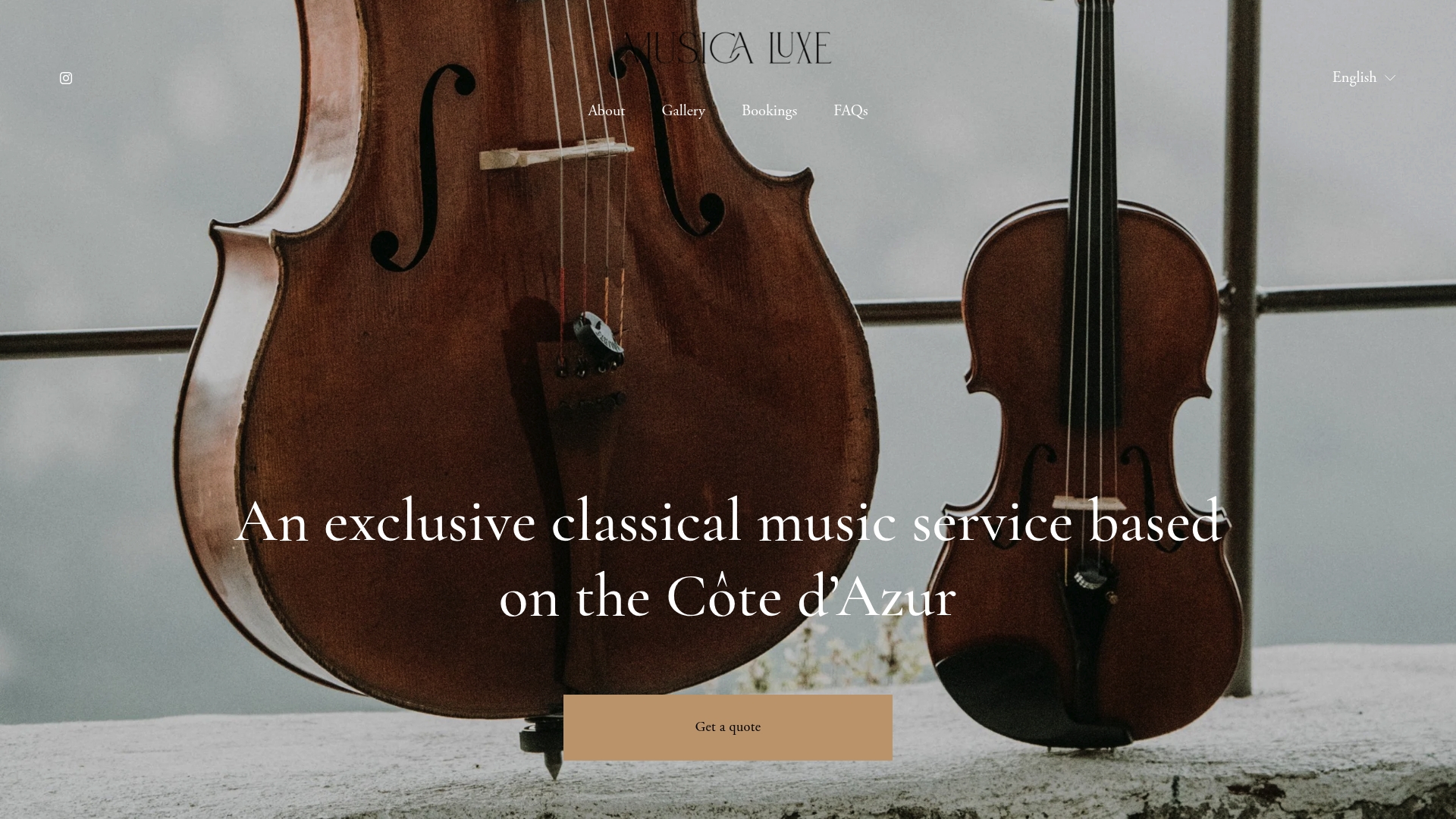
To see the ensembles and settings we work in, browse our gallery. When you are ready to talk about your event, tell us about it and we will come back with a considered proposal.
FAQ
What kind of music suits a luxury brand event?
Music that matches the brand's identity and the mood you want guests to feel. Classical and orchestral sound suits brands built on heritage and craft, while other houses lean toward electronic or eclectic styles. Whatever the style, live musicians of real quality make the choice credible.
Can a string quartet play contemporary music for a brand launch?
Yes. A skilled quartet can perform arrangements of pop, film, jazz or electronic material in a classical voice. This lets you keep the elegance of strings while nodding to the brand's own world. Agree the arrangements early so there is time to write and rehearse them.
Is live music practical for a fashion show?
It is, with planning. Runway timing shifts, so the ensemble needs a leader who follows the producer's cues and arrangements with flexible endings. Rehearse with the real run of show, and plan the sound check around venue access.
How far ahead should I book musicians?
As early as the date and venue are settled, and for a runway or launch, as the concept is forming. Early contact leaves time for custom arrangements, rehearsal and a venue acoustic check. Peak season on the Riviera fills quickly.
How do I know the musicians are really playing live?
Ask for unedited live video of the exact lineup, check biographies against named institutions and engagements, and ask directly whether any backing track is used. Serious professionals answer plainly and welcome the questions.
Sources
- Inside the booming business of background music, The Guardian
- FNAC Live study, Instituto Politécnico de Leiria repository
- Mercedes-Benz lounge customer story, Soundsuit
- Luxury Shoppers' Experiences With Background Music, IGI Global
- How Music Can Make a Brand More Luxurious, The Marketing Society
- Music at Hermès, La Lanterne d'Hermès à Ginza
- Sound and the Brand, BrandedSong
- Benji B on booking Cybotron for Louis Vuitton, WWD
- How to produce a killer fashion show soundtrack, Vogue
- Decoding the Art of Show Music with Benji B, END.
- How to make a custom runway show soundtrack, Vogue
- 2025 Showcasing FAQs, Western Arts Alliance
- Competition Official Regulation, Jazz in the Park